

Written by Hon. Chief Matthew Ekwuribe
Today, Governor Alex Otti will perform the official flag-off of the reconstruction of the Enyimba International Hotel at Ogbor Hill, Aba, in partnership with Radisson Blu. The ceremony marks a defining milestone in the state’s infrastructure renewal drive and signals a bold leap towards restoring Aba’s standing as a premier commercial and hospitality destination in Nigeria.
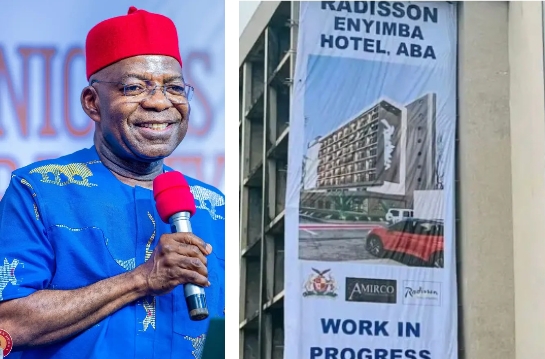
The event which has the theme, “From Vision to Structure; The Phoenix of Aba,” captures the spirit of rebirth that defines both the project and the city itself. Aba, the commercial nerve centre of the state, long celebrated for resilience, enterprise and industrial ingenuity, is once again rising. This time through deliberate policy, structured investment and visionary leadership aimed at repositioning it for sustainable growth and global relevance.
The Enyimba International Hotel was originally built in 1979 by the late former Governor of Imo State, Sam Mbakwe, as a bold economic landmark for the South East and beyond. The reconstruction of this iconic hotel under Governor Otti represents more than bricks and mortar, it embodies restored confidence, renewed purpose and a recalibrated economic direction for Abia State.
Central to this transformation is the strategic collaboration with Radisson Blu, a globally respected hospitality brand known for it’s operational excellence and international standards. By securing such a reputable management partner, the Abia State Government has sent a powerful message to investors worldwide: Abia is stable, reform-driven and open for premium business.
International brands stake their reputation carefully and this partnership underscores the growing credibility of the state’s leadership.
The 250-room, five-star facility is being redesigned to meet world-class standards capable of hosting international conferences, investment summits, corporate retreats, exhibitions and destination events. For a city widely regarded as the commercial heartbeat of the South East, the absence of upscale accommodation had long limited its full economic potential. This intervention decisively bridges that gap and redefines Aba’s hospitality landscape.
The reconstruction of the Enyimba International Hotel, which is to be supervised by the Greater Aba Development Authority (GADA), underscores the present administration’s commitment to professionalism, structure and strict quality control.
Under the able leadership of the Director General, Arch. Uche Ukeje, GADA will ensure that the project aligns with the urban renewal blueprint of Governor Alex Otti and meets global construction and safety standards. The Authority’s involvement guarantees meticulous planning, adherence to timelines, transparency in execution and delivery of a facility that reflects the new development standards being institutionalized across Aba.
Beyond supervision, GADA’s coordination role ensures that the hotel reconstruction integrates seamlessly with the broader regeneration of Aba’s infrastructure, including road networks, drainage systems, environmental aesthetics and urban design improvements. This strategic oversight reinforces the Governor’s holistic approach to city transformation, where flagship projects are not treated in isolation but embedded within a comprehensive development framework designed to reposition Aba as a modern, competitive and investment-ready metropolis.
Governor Otti’s broader commitment to transforming the tourism and hospitality industry is being vigorously implemented through the Ministry of Arts, Culture and Creative Economy. The ministry has embraced tourism as productive infrastructure, an economic driver that stimulates commerce, generates employment and expands internally generated revenue. Through stakeholder engagement, policy reforms and investor-friendly frameworks, the ministry is methodically laying the groundwork for a resilient and competitive tourism ecosystem.
The determination to actualize this vision is evident in the administration’s emphasis on standardization, innovation and public-private partnership. By aligning government support with credible private sector expertise, the state is ensuring sustainability, efficiency and measurable performance outcomes. This model reduces operational risk while positioning Abia as a serious contender within Nigeria’s hospitality market.
Economically, the impact of the reconstructed hotel will be far-reaching. Over 5,500 direct and indirect jobs are projected across construction, engineering, hospitality services, catering, transportation, entertainment, logistics and small-scale supply chains. For thousands of families, this translates into steady income, skill acquisition and improved living standards. The multiplier effect will extend beyond the hotel premises, stimulating growth across multiple sectors of the local economy.
In terms of revenue, the hotel is expected to significantly boost Abia’s Internally Generated Revenue (IGR) through taxes, service charges, tourism spending and increased commercial activities around Ogbor Hill and its environs. Property values are likely to appreciate, new businesses will emerge to meet rising demand and financial resources that previously flowed to other cities for conferences and major events will now circulate within the state thereby strengthening economic retention and growth.
As this landmark project is flagged off today, it stands as both a policy statement and a call to collective responsibility. The reconstruction of the Enyimba International Hotel is not merely a government initiative, it is a shared investment in Abia’s future.
Abians are therefore encouraged to continue to rally behind Governor Otti, whose uncommon zeal continues to reposition the tourism and hospitality sector into a dynamic engine of development, making Abia not just a commercial powerhouse, but a true one-stop tourism destination in Nigeria and beyond.
Hon. Chief Matthew Ekwuribe
Commissioner, Ministry of Arts, Culture and Creative Economy,
Abia State