

By
ELEOGU LUCKY NKEM PhD, FCAI, MNIIA, DFILMMD, PMP,
International Relations and Diplomacy, Nigerian British University Asa, Abia State
The Ipu West Autonomous Community of Owaza Ancient Kingdom has, through deliberate action and disciplined coordination, demonstrated that true development is neither accidental nor cosmetic, but the product of vision guided by structure.
The operationalization of the ₦4 million Youth Empowerment Initiative funded by Engr. Nwoke Adinigwe stands not merely as an act of generosity, but as a carefully engineered intervention that elevates empowerment from the realm of charity to that of institutional transformation.
In a socio-economic environment often burdened by unstructured interventions, this initiative introduces a refreshing departure to one anchored in transparency, accountability, and professional foresight.
What has unfolded in Ipu West recently is a quiet but profound shift in development philosophy: from episodic handouts to a system-driven model that recognizes that the dignity of the human person is best preserved through capacity, not dependency.
The formation of a functional management and implementation committee, in strict adherence to the donor’s directive, reflects an understanding that leadership must be collective to be sustainable. By embedding representation and responsibility within the community, the programme insulates itself against arbitrariness while strengthening ownership; an essential ingredient often missing in grassroots interventions witnessed in various capacities from most of our representatives.
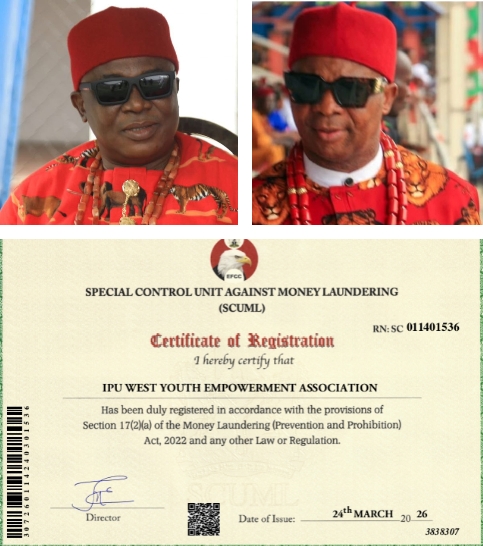
The legal registration of the initiative as the Ipu West Youths Empowerment and Skill Acquisition Programme as registered ®️ with the Corporate Affairs Commission, alongside the constitution of a Board of Trustees, signals a transition from informal coordination to institutional permanence.
In philosophical terms, this act transforms a temporal intervention into a structure capable of outliving its founders, echoing the Aristotelian notion that enduring systems are those grounded in order and purpose. Development, in this sense, becomes not an event, but a continuum.
Equally significant is the establishment of a dedicated financial architecture through a designated account with Access Bank. This is more than an administrative requirement; it is a moral statement about stewardship.
In societies where mistrust often undermines collective initiatives, financial transparency becomes both a technical necessity and an ethical obligation. By ensuring traceable transactions and eliminating discretionary handling of funds, the programme reinforces confidence and legitimizes its processes in the eyes of the community.
The progression to the stage we are now, where beneficiaries are invited to submit proposals or requests alongside guarantors introduces a culture of merit, responsibility, and seriousness. It subtly redefines empowerment as a contract rather than a gift; one that demands commitment, discipline, and accountability from participants or beneficiaries.
This approach aligns with modern development thinking, where beneficiaries are not passive recipients but active stakeholders in their own advancement.
At the center of this transformative process is the visionary intervention of Engr. Nwoke Adinigwe, whose timely release of funds- the sum of ₦4 million few days ago has translated intent into reality. His approach reflects a refined understanding of development as a function of structure, not sentiment. By insisting on systems, governance, and accountability, he positions himself not merely as a donor, but as a builder of institutions. His legacy, therefore, is not in the money given, but in the model created.
Complementing this vision is the strategic and intellectual contribution of Dr. Eleogu, Lucky Nkem, FCAI, MNIIA, whose professional guidance has provided the conceptual and operational clarity required for success. His three-tier hybrid empowerment framework granted as a tutorial to the youth body embodies a synthesis of theory and praxis, demonstrating that effective community development must be both intellectually grounded and contextually responsive. His continued advisory role to the youth executives and committee underscores the importance of knowledge leadership in ensuring that noble intentions are translated into measurable outcomes.
From an academic perspective, the initiative resonates strongly with established development paradigms. It affirms the centrality of human capital as the bedrock of economic progress, recognizes the necessity of sustainable livelihood systems in building resilience, and validates the effectiveness of community-driven approaches in fostering ownership and continuity.
Professionally, it reflects adherence to global standards in governance, financial management, and programme implementation; an indication that local initiatives can indeed meet international benchmarks when guided by discipline and expertise.
The broader implications for Ipu West youths are both immediate and far-reaching. By equipping youths with relevant skills and supporting enterprise development and artisanship, the programme addresses the structural roots of unemployment and restiveness.
By stimulating local economic activity, it contributes to the emergence of a self-sustaining community ecosystem capable of interfacing productively with the oil and gas economy that defines the community and region at large. More importantly, by institutionalizing transparency and participation, it rebuilds trust which arguably is the most critical currency in community development.
Ultimately, what is being constructed in Ipu West Autonomous Community is more than an empowerment programme; it is a philosophy in action which is a demonstration that development must be intentional, structured, and ethically grounded to be meaningful.
Engr. Nwoke Adinigwe’s intervention transcends philanthropy and enters the realm of legacy, while the professional stewardship of Dr. Eleogu, Lucky Nkem ensures that this legacy is not ephemeral but reliable and replicable. As implementation deepens, the initiative stands poised not only to transform individual lives but to redefine the trajectory of community-led development within Owaza Ancient Kingdom and beyond.
IPU West Keleenu!
Dr. Eleogu, Lucky Nkem FCAI, MNIIA
Ipu West -Owaza Ancient Kingdom
Ukwa West LGA
Abia State
23/04/2026